Monday, August 15, 2011

Upstage, Downstage

I'm back with another fun day of theater help. Today's Topic: Stage directions

No, not those pesky things written in italics in your script. Though I should write about them as well. I mean when your director says "Move upstage" or "Cross to right stage" and you look at him with that deer-in-the-spotlight look because....you don't know where to go!

No problem, gentle readers. I'm here to help.


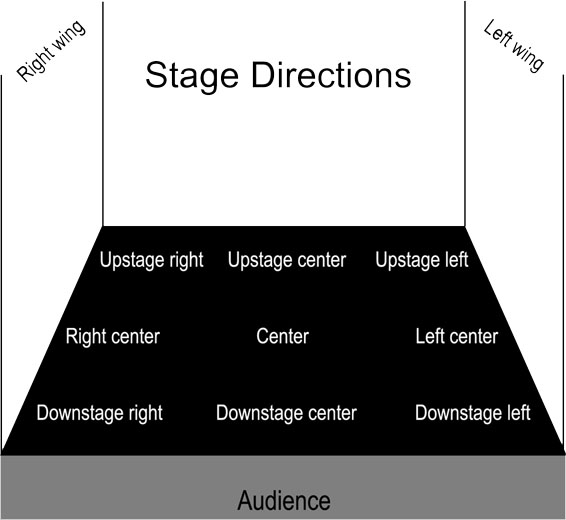
As we can see by our handy-dandy illustration....this can be confusing. The first rule to remember is: Directions are to be followed from the point of view from the actor onstage. So when you're onstage and your director tells you to walk to stage right, you walk towards YOUR right. (That's the hand that doesn't make the L when you hold them up.) Nevermind what the audience would think. This is all about you, baby!

Now we come to that upstage/downstage thing. This is where it gets interesting. "Back in the day" y'know the 17th and 18th Centuries....maybe B.C..... stages were actually tilted down towards the audiences. That way the chorus people in the back could still be seen. They weren't tilted much, maybe only a grade of a few inches. But it helped! So nowadays when we say "upstage" we mean the back of the stage, which was "up" from the front! Likewise, "downstage" means the front of the stage, or the part that is lowest.

Make sense?

No?

Maybe you should gift yourself this t-shirt then, for help:


Saturday, August 13, 2011

Know When to Hold 'Em, Know When to Fold Em

So, I'm back in another play and I thought it was high time to pick up my theater ramblings again. Tonight's theme: know when you're the wrong age to play a part.

Now, there are times when it's alright to grossly miscast someone in a part they are too old or too young to play. And those are: high school and college. These are places and times when the casting pool has only a three-year age range so everyone has to play up or down in their age range. And it's expected. And costuming, makeup and a darn good director (who can coach the actors on walk and mannerisms) can help with showing a greater range of ages than there are in the cast. Case in point: my high school did The Crucible. And the girl playing Rebecca Nurse was actually younger than the girl playing Abigail. No problem. It was high school. You can get away with it there.


Oh look, they're all the same age!

But in the real world, and yes, I'm calling community theater the real world, the audition pool is mercifully larger than your high school drama club's. Old men can be played by, get this, old men! Middle age mothers can be played by....any guesses? Middle aged women! And ingenues can be played by teenaged girls.

Ahhh....all is right with the world.

Or is it?

Ladies and gentlemen. Take a good look at your driver's license. I know the picture isn't flattering, but it is honest. If you look like an old man, you can't play young heartthrobs. If you look like a middle-aged mother, you can't play ingenues. I don't care how much vocal training, make up, wigs, or working out you do. You look too old for some parts out there. I have yet to meet a director in community theater who can direct well enough to get a mediocre actor to give such a stellar performance that the audience believed he was markedly older or younger than he really was.

Luckily, we have old women who audition for Rebecca Nurse in community theater productions of The Crucible. And we have teenagers who audition for Abigail.

Middle-aged women and men, ya need to be honest with yourselves and realize, you need to start putting away the dreams of playing Gypsy or Brick, and you're gonna have to audition for Mama Rose or Big Daddy. If you're a parent in real life, chances are you can't play the child onstage.

Which brings me to ingenues. Yes, I still thought I could play Liesl in The Sound of Music until I was 24. I held onto that dream, because I thought I was young enough, talented enough, and gosh-darn it. People liked me! But then I saw my friend play Liesl and she was 14. *gulp* I realized then and there that I had outgrown one of my dream roles. Because I couldn't compete, at 24, with the *acutal* dewey-eyed, naïveté of a real teenager! Ah well. Time for me to audition for Sister Margarettta in my twenties.

Yes, it was hard for even me to put some roles up on the Roles That Got Away Shelf. It was hard. It was hard to tell myself "Hey, you're not a sweet, young thing anymore. Let the pretty parts go to the pretty young girls." But I did. And I'm better off for it, because there are better parts for twenty- and thirty-somethings out there than the one-dimensional ingenues.


OMG look! An adult playing an adult, and children playing children! Will wonders never cease?

The only thing sadder than people not realizing when they're too old for a part, is directors who continually miscast them. Because they're only perpetuating the empty dream. But that's another blog post.

Let it go. You'll be ok.
Saturday, June 11, 2011

Thank your Stage Manager

Stage Managers are awesome people. They do a lot of grunt work that actors and directors don't want or don't have time to do.

Before a performance, in addition to checking props and sets and lights and the house and wayward actors they call out how many minutes there are until the curtain rises. It is proper etiquette to thank your stage manager and repeat the minute call. This lets your SM know that you heard him correctly and you know how long you have to get ready. So if your SM says "15 minutes to places." Your proper response is "Thank you, 15".

Stage managers are awesome. They find lost props during shows and cal light cues and put heels back on broken shoes and lace corsets and if you're really lucky they bring you flowers on preview night AND opening night. Ok, I'm just a really lucky girl with an incredible SM right now. :)

But yes, always thank your Stage Manager. They work hard.

Tuesday, May 3, 2011

Break a Leg!

Ahhhh yes. That phrase that every non-thespian wonders about. It's what actors say to each other to wish each other luck. Why do we say it? I really don't know. But we do.

Some theories. My personal favorite is that we're just being backwards and we're wishing "bad" luck to be backwards when we really mean "good" luck.

Another popular theory I've heard is that it refers to taking a bow, when one "breaks the line" of the leg. So in that sense it does mean good luck, because we want each other to have a successful reception from the crowd.

So there you go.

Wednesday, January 26, 2011

Dramatis Personae

Another thing I have found in community theater is the inexplicable phenomenon of people calling each other by their character names. Sometimes this happens when actors have never met each other before, sometimes it happens months after a show closes. It's a pet peeve of mine. I have a name. And it's not Abigail Williams or Corrie Bratter or any other character I've played.


I do find it acceptable when a director is in the middle of giving notes, because he's watching you portray your character, and he wants a certain something from the character, and doesn't necessarily mean the actor.


But once, two months after Steel Magnolias closed, the producer called me "Shelby". I tried to politely tell her that Shelby was my character, not my name.


The worst is when people, and I mean co-actors in the show with you, confuse you the person with your character. When I did The Crucible, castmembers actually asked me if I was sleeping with the actor playing John Proctor. And they called me a whore. REALLY?! That's my character.........If you can't tell the difference between reality and fantasy, between me the person and the character whose lines I'm reading off a page....maybe you should find a new hobby. Sorry to bitch, but it gets my goat. Please don't confuse me with the fictional character I'm portraying onstage for two hours a night.

It's the same as when, watching Harry Potter and the Goblet of Fire, someone says, "It's Edward Cullen!!" No. It's not. It's an actor named Robert Pattinson, and he's portraying a character named Cedric Diggory at the moment. Gyuh.


So I guess what I'm saying is, do your friends in your cast a favor and learn their name, and call them that when they're not onstage ;)

Tuesday, January 18, 2011

Line!

During rehearsals, sometimes we all forget our lines. It happens. It's part of the learning process. There comes a point in the rehearsal procdess when you try, or have, to be off book. And sometimes you need help remembering what you're supposed to say. At such times the correct etiquette for asking the bookholder to tell you your line is to freeze in your position and say:

"Line."

That's not "What the fuck is my line?" or "Oh! Oh! I know it...it's uhm.......What is it?" or the ever popular "Don't tell me....don't tell me...." It's "Line." Pure and simple. Don't look at the bookholder, because then you're breaking character further and it's harder to get back into the emotion of the scene you and your partners have been working on. Then you say your line and go back to the scene.

It is also very nice to thank the bookholder at the end of rehearsal. Not in the middle of your scene. Rehearsal is a time for rehearsing. And that means staying in your character when you're onstage. Which is why you make no fuss about asking for your lines. I know it's embarrassing. I've been there with the forgetting my line. But it's no big deal, and just get back to your acting.

Also, as a bookholder, it sucks to hear all those things up there "Oh ..it's something like....what is it?" No. I'll give you your line when you calmly say "Line." We don't mind telling you. Really. That's why we're on book. But I really don't like babying you by giving you your line unless you ask for it properly. It's just courteous to not make a big fuss and fluster your co-actors, getting them out of character and breaking the energy of the scene.

More importantly, this is a universal request word. Not every stage manager knows when you really want your line, and when you'll push on and fight your way through the scene. Sometimes you're pausing for dramatic effect. Sometimes it's on the tip of your tongue and you'll get it. There's really nothing more frustrating for an actor who's trying her best to fight her way through a scene and not break emotional continuity than for a bookholder to butt in and say, "No, your line is..." It really takes the actors out of their emotional groove.

So for bookholders: Don't give the line unless they say....what is it? Say it with me, "Line."

So. Now we know, and knowing is half the battle.

Saturday, January 15, 2011

Second Most Important Lesson

I was doing a production of Barefoot in the Park in 2004 (maybe 2003). And we were blocking a scene where my character is supposed to be seducing her husband. So I asked the director if I could take my shirt off. And he said, "Why?" And I said, "Well because Jane Fonda did in the movie." And he replied,


"If the audience wants to see Jane Fonda they can rent the movie. They're paying to see you."


Wow. That hit me. As an actress, you should never try to copy someone else's performance. If the audience is expecting Jane Fonda in BITP, they should just go watch the movie. Or Julie Andrews in The Sound of Music, or anyone else. They've come to see a live performance, with entirely different actors and an entirely different director on a stage, not a movie set. It won't be the same, it can't be the same, nor should it be the same. That's the beauty of live theater. It's always different from production to production, company to company and even night to night. It's live.

But most importantly: It's you. You, whoever you are, bring so many different qualities to the table than [insert famous actress' name here]. You're not her, and therefore can't portray the character like her. You have different life experiences, are coming at the script from a different place inyour life. And why should you just want to copy? a) Where's the fun in that? b) Where's the growth in that? Oh, you can copy someone famous' performance. Grrrrreeeeat. That doesn't take talent. Be creative. Be yourself.

I can't tell you how many times while I was doing The Crucible, that people told me "Oh, you'll be a great Abigail! You look just like Winona Rider."

Uhm. Wow. Smack in the face much? So I have no talent of my own, I just happen to look like someone who played this character once? Thanks. For nothing. I went on to make the character my own, and politely told those people to eff off. Those are the type of audience members who wouldn't understand the art of theater anyway.